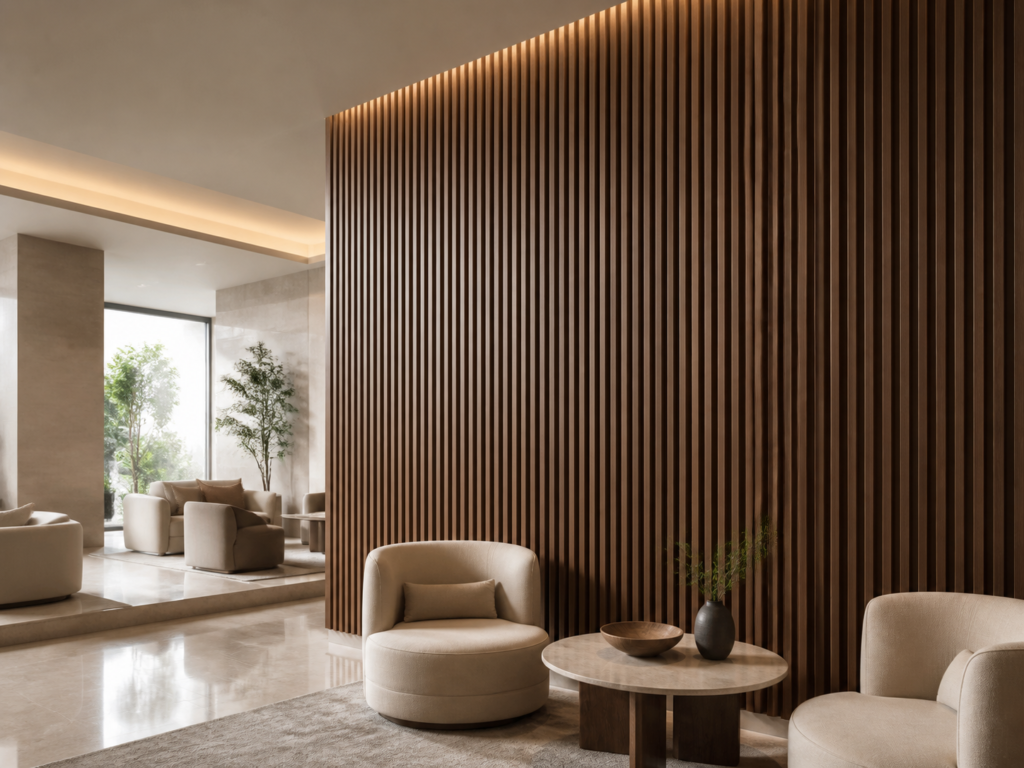
The same wall panel is not automatically suitable for every interior. Each application changes the priorities for appearance, traffic, cleaning, maintenance access, installation time and documentation.
Application decision matrix
| Application | Primary questions | Useful direction | Evidence to request |
|---|---|---|---|
| Residential | Room scale, lighting, furniture palette, cleaning routine | Warm woodgrain, restrained profile depth, coordinated edges | Finish sample, dimensions, installation method |
| Office | Reception impact, repeated areas, program and maintenance | Fluted features or calm integrated modules | Batch/finish control, packaging, installation sequence |
| Hospitality | High visual expectation, repeated rooms, cleaning and replacement | Approved sample, repeatable finish and documented room type | Project-required tests, sample approval, spare-material plan |
| Retail | Fast fit-out, brand color, frequent display changes | Modular panels and clear replacement/trim strategy | Lead time, package unit, installation and maintenance guidance |
| Renovation | Existing wall condition, access, dust and downtime | System selected after substrate survey | Substrate compatibility and site fixing approval |
Questions to answer before selecting a model
- Is the wall decorative only, or does the project specification require documented fire, emission or moisture performance?
- Will panels be vertical, horizontal or coordinated across wall and ceiling zones?
- Can the substrate accept adhesive or concealed fixings, or is a subframe required?
- Where are external corners, internal corners, openings, service panels and exposed ends?
- How will damaged panels be accessed and replaced?
Use the application to improve the inquiry
Send room type, wall dimensions, substrate photographs, design references, preferred finish, estimated quantity, destination and required documentation. This allows the supplier to recommend a configuration instead of only quoting a generic panel.
Explore the Applications page, review finish directions, and calculate a preliminary quantity with the quantity and waste calculator.