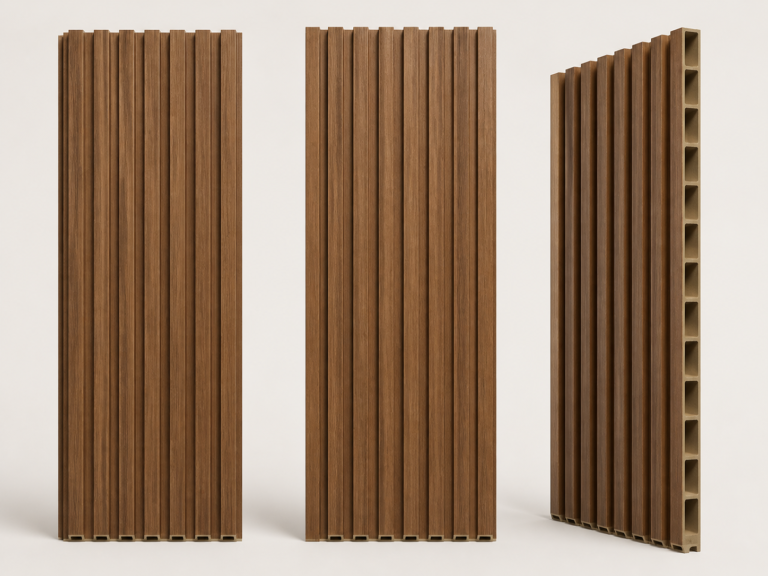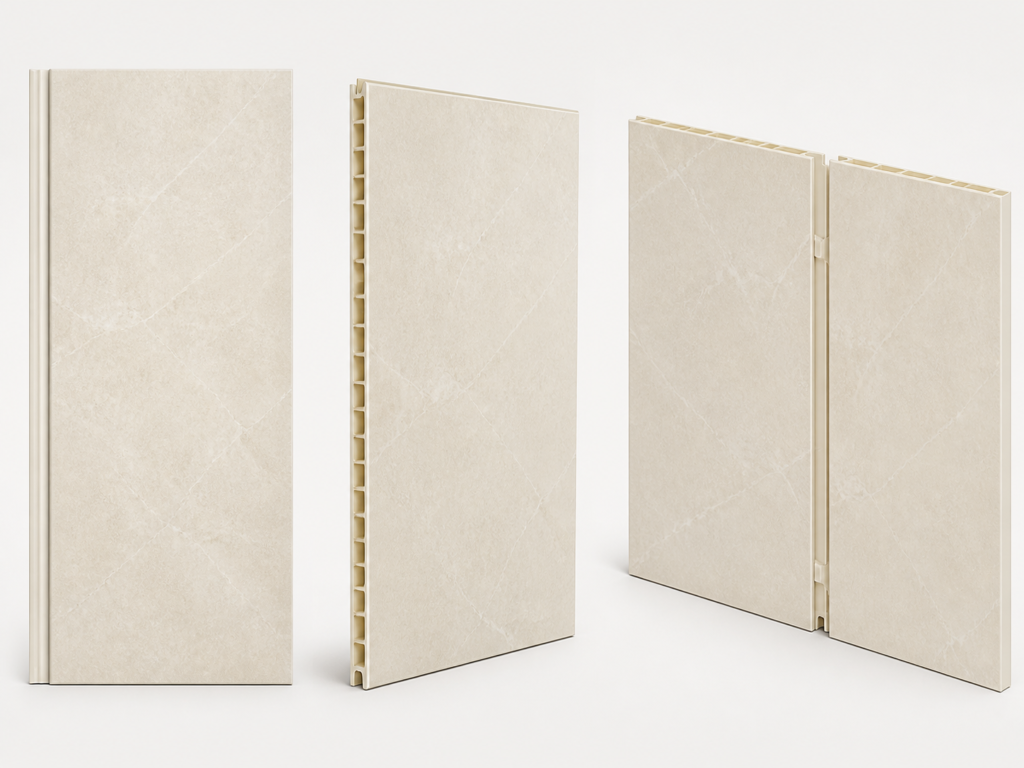
Fluted and integrated panels can both create finished interior walls, but they solve different design and installation problems. The better choice depends on visual rhythm, panel handling, joint strategy and the wall condition.
Quick comparison
| Factor | Fluted wall panel | Integrated wall panel |
|---|---|---|
| Design effect | Pronounced ribs or grooves; strong shadow lines | Broader continuous modules; quieter surface |
| Key dimensions | Overall width, profile depth, count/repeat, effective coverage | Overall width, thickness, joint and effective coverage |
| Best planning use | Feature walls, reception backdrops, retail zones, vertical accents | Long wall runs, coordinated wall/ceiling areas, modular interior lining |
| Installation focus | Datum, profile continuity and edge finishing | Long-panel handling, joint engagement and trim coordination |
| Finish decision | Grain direction must work with the fluted geometry | Finish repeat and joint visibility matter over larger modules |
Choose fluted when…
- The design needs a clear linear feature.
- Shadow, depth and directional emphasis are important.
- Smaller modular widths make site handling easier.
- Edges and transitions can be coordinated with suitable trims.
Choose integrated when…
- The project favors wider, calmer wall modules.
- Long continuous lengths can reach and be handled at the site.
- A coordinated 8 mm panel-and-trim package is useful.
- The exact joint and effective coverage can be confirmed before quantity calculation.
Do not compare only by price per square meter
Include trim quantity, package protection, loading efficiency, installation labor, substrate preparation, waste, sample approval and documentation. A lower unit price can create a higher project cost if the panel format is difficult to transport or requires more site correction.
JH WPC’s current public models are inquiry-only market-reference configurations. Final joint geometry, finish, packing, MOQ and lead time are confirmed in writing.