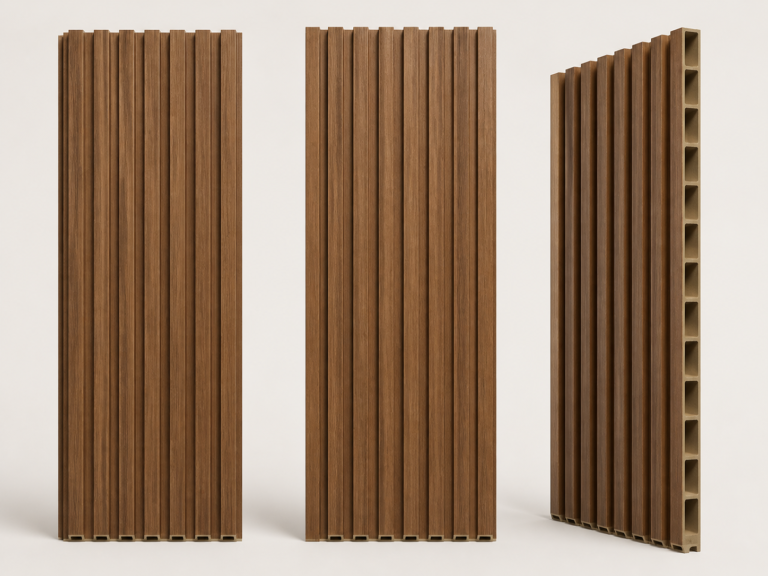
WPC panels can look identical in a supplier’s catalog yet carry very different prices, weights, and loading costs. That makes a cheap quotation surprisingly risky. I avoid this problem by defining the panel specification first, normalizing every offer, and comparing the realistic cost of a full container rather than one isolated price per square meter.
WPC panels commonly cost about US$2.30–US$3.20 per square meter for engineering-grade, hollow, PVC-based products in recent first-half 2026 export quotation comparisons. This conditional FOB China reference assumes 3,000 × 400 × 8 mm panels, approximately 4.5–5.5 kg/m² gross weight, and full-container quantities. Buyers should request a current quotation for an exact specification.

That reference range is only a starting point, not a universal market price. I still need to examine the substrate, profile, wall thickness, weight, finish, packaging, quantity, and container plan before deciding whether two quotations cover genuinely comparable products.
What Is the Current Price of WPC Panels?
A broad WPC panel price can create more confusion than clarity. Suppliers may use the same product name for PVC-based hollow panels, heavier wood-plastic profiles, decorative interior boards, and exterior cladding. I therefore attach every price range to a defined product and purchasing condition.
For 3,000 × 400 × 8 mm hollow PVC-based engineering panels weighing approximately 4.5–5.5 kg/m² gross, I use US$2.30–US$3.20/m² FOB China1 as a conditional first-half 2026 reference for full-container inquiries. Color, finish, packaging, order mix, raw-material costs, and loading quantity can move the final price.

A price needs a specification
When I review a quotation, I expect the supplier to place the price beside a technical description. A line that only says “WPC wall panel: US$2.45/m²” is incomplete.
At a minimum, I ask for:
- Product composition: PVC-based composite, wood-plastic composite, or another declared formulation
- Profile type: hollow, solid, fluted, flat, or decorative
- Finished dimensions: length, width, and thickness
- Coverage calculation: nominal width versus effective installed width
- Unit weight: preferably both net product weight and gross shipping weight
- Surface finish: plain film, laminated film, printed finish, or coated finish
- Packaging: pieces per carton, protective film, corner protection, and pallet use
- Quantity: square meters, pieces, and number of containers
- Trade term: EXW, FOB, CFR, CIF, or another Incoterm
- Quotation date and validity: especially when freight or raw-material costs are changing
My reference range applies to the following general procurement profile:
| Quotation factor | Conditional reference |
|---|---|
| Product | Hollow PVC-based engineering-grade wall panel |
| Dimensions | 3,000 × 400 × 8 mm |
| Coverage per piece | 1.2 m² before any installation adjustment |
| Gross unit weight | Approximately 4.5–5.5 kg/m² |
| Order size | Full-container quantity |
| Typical buyer | Engineering wholesaler or large importer |
| Trade term | FOB China |
| Reference period | First half of 2026 |
| Indicative range | US$2.30–US$3.20/m² |
This range does not cover every product marketed as WPC. A heavier exterior-grade profile, a solid board, or a product made for a regulated high-end market should not be compared with this engineering-grade reference.
I also treat any online price as time-specific. Resin prices, additives, decorative films, exchange rates, and factory utilization can change an offer. I recommend obtaining a quotation with a validity period and then reconfirming it before paying a deposit.
I use price ranges to screen suppliers. I use complete written specifications to select them.
Why Do WPC Panel Prices Differ So Much?
A low price often results from a different physical product rather than better purchasing efficiency.2 In the quotation comparisons I handle, small differences in unit weight, internal wall thickness, raw-material formulation, surface film, and packaging can materially change both price and shipping performance.
WPC panel prices differ because the “WPC” label does not define one standardized product3. Substrate, hollow structure, dimensions, weight, finish, packaging, order volume, and quality-control requirements all affect cost. Buyers should compare these variables line by line before treating two prices per square meter as equivalent.
Weight can explain an unusually low offer
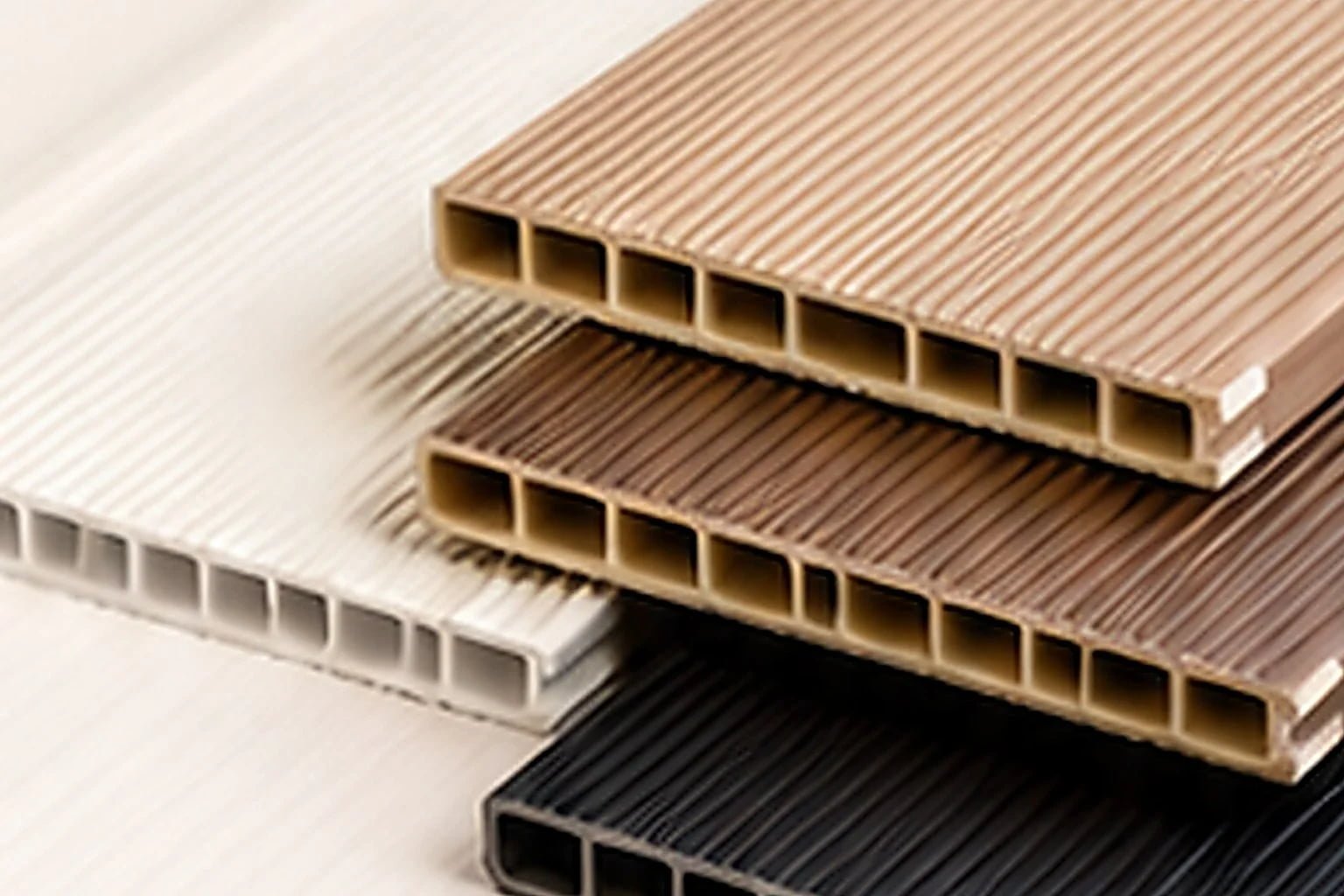
Weight is one of the first figures I check. If one nominally identical panel is substantially lighter, the supplier may have changed:
- The internal rib structure
- The outer skin thickness
- The profile wall thickness
- The raw-material formulation
- The proportion of mineral filler
- The dimensions or usable width
A lighter product is not automatically unsuitable. Some buyers intentionally source a lower-cost profile for price-sensitive interior projects. However, I do not treat a 4.5 kg/m² panel as automatically equivalent to a 5.5 kg/m² panel just because both are described as 8 mm thick.
For example, consider two simplified offers:
| Item | Offer A | Offer B |
|---|---|---|
| Nominal size | 3,000 × 400 × 8 mm | 3,000 × 400 × 8 mm |
| Gross weight | 4.5 kg/m² | 5.4 kg/m² |
| FOB price | US$2.36/m² | US$2.52/m² |
| Difference | — | US$0.16/m² higher |
| Directly equivalent? | No | No |
Offer A is cheaper, but the table does not prove that it offers better value. It only proves that it costs less and weighs less. A buyer still needs to inspect the profile drawing, sample, dimensional tolerance, finish, and intended application.
Surface treatment changes the price
Decorative film is another variable. A standard wood-grain film may carry a different cost from a thicker film, a custom color, or a finish that requires a minimum production run. Color mixing can also reduce production efficiency.
I usually clarify:
- Whether the quoted film matches the approved sample
- Whether the film code will remain consistent across batches
- Whether custom colors require a surcharge
- Whether mixed colors reduce the container quantity
- Whether protective film is included
- Whether the supplier warrants sample-to-bulk consistency in writing
Packaging is part of the product cost
Thin export packaging can reduce the quoted price, but it can increase handling and transport losses. In emerging-market routes, the industry can experience approximately 3%–5% transport damage4, depending on packaging, loading, unloading, inland handling, and route conditions.
I therefore ask whether the price includes:
- Protective surface film
- Export cartons or woven wrapping
- Reinforced ends and corners
- Moisture protection
- Loading bracing
- Replacement pieces or an agreed damage allowance
I prefer a slightly higher, clearly documented quotation to an attractive number that leaves packaging and replacement responsibility undefined.
How Should I Compare WPC Panel Quotations?
Supplier quotations are often presented in different units and formats. One factory quotes by piece, another by square meter, and another by carton. Unless I normalize those figures, a small difference in usable width or packing quantity can distort the apparent result.
I compare WPC panel quotations by converting each offer to the same usable square-meter basis and checking identical dimensions, weight, profile, finish, packaging, quantity, and trade terms. I then calculate container-level and landed costs. I do not rank offers using the headline unit price alone.

Convert every price to the same basis
A 3,000 × 400 mm panel has a nominal face area of:
3.0 m × 0.4 m = 1.2 m²
If the supplier quotes US$2.94 per piece, the nominal square-meter price is:
US$2.94 ÷ 1.2 m² = US$2.45/m²
However, this calculation only works if 400 mm is the effective coverage width. Some profiles include an overlapping or interlocking edge. In that case, installed coverage can be less than the nominal panel width5.
I ask suppliers to confirm both:
- Overall manufactured width
- Effective installed coverage width
That small distinction matters across thousands of square meters.
Use a normalization sheet
I use a comparison table like this for full-container inquiries:
| Comparison point | Supplier A | Supplier B | Supplier C |
|---|---|---|---|
| Product composition | |||
| Profile drawing supplied | |||
| Finished size | |||
| Effective coverage | |||
| Net weight per m² | |||
| Gross weight per m² | |||
| Pieces per package | |||
| Surface film code | |||
| Price per piece | |||
| Normalized price per m² | |||
| 40HQ loading quantity | |||
| Estimated damage allowance | |||
| Production lead time | |||
| Trade term and port | |||
| Payment terms | |||
| Quote validity |
An anonymized quotation example
In one type of inquiry I regularly encounter, three suppliers may appear to quote the same 3-meter panel. One offers US$2.38/m², another offers US$2.45/m², and the third offers US$2.52/m².
The offers stop being directly comparable after I check them:
- The first panel weighs less and uses simpler packaging.
- The second includes reinforced export packing and a stable film code.
- The third is heavier but loads fewer square meters because of its weight and carton arrangement.
The cheapest quotation may still be appropriate for a budget project. However, I cannot reach that conclusion from the price alone.
Confirm the bulk-order specification
I have seen inquiries where a sample looked acceptable, but the bulk-order specification remained too vague. I reduce this risk by attaching the approved details to the purchase order.
The confirmation should cover:
- A signed reference sample
- A profile cross-section or drawing
- An agreed unit-weight range
- Dimensional tolerances
- Surface film code and color
- Packaging method
- Inspection procedure
- Treatment of shortages and damaged goods
- Loading quantity
- Delivery deadline
I present these controls as procurement safeguards. Application suitability, structural behavior, fire performance, and installation design should be assessed by qualified professionals for the specific project.
How Does Container Loading Affect the Real Cost of WPC Panels?
Importers purchase containers, not abstract square meters. A supplier can offer a lower panel price but load fewer saleable square meters into the same 40HQ container. Freight, clearance, inspection, and destination charges then have to be divided across a smaller quantity.
Container loading affects WPC panel cost because panel length, gross weight, packaging volume, mixed colors, and loading arrangement determine how many square meters fit in a shipment. Buyers should divide the complete container cost by the expected saleable quantity after allowing for shortages and damage.
Weight and volume can both limit a 40HQ
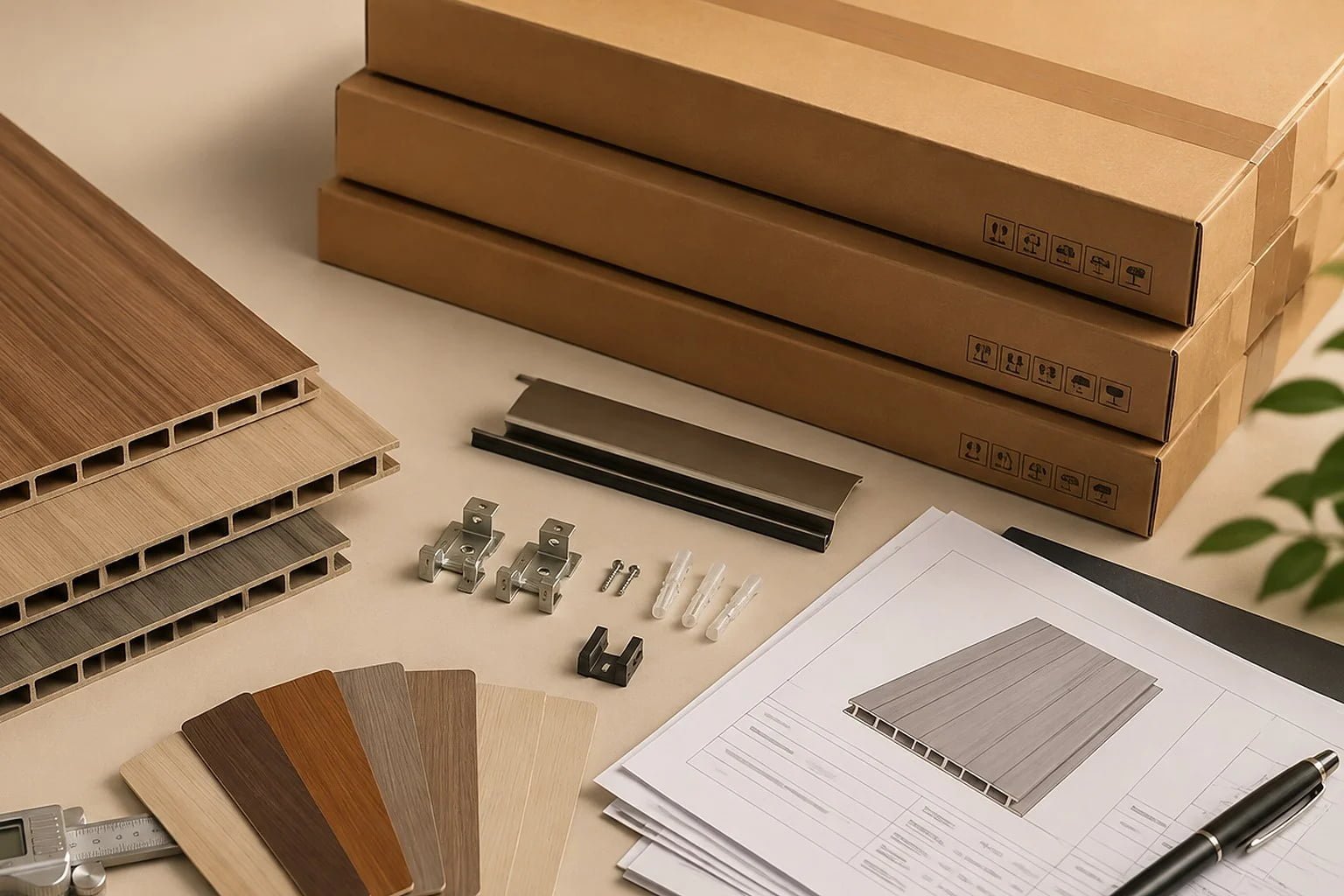
A 40HQ container has a nominal internal volume of roughly 76 cubic meters6, although practical loading space is lower. Its payload also depends on the specific container, shipping line, road rules, and verified container plate.7
For panels with a gross shipping weight of 4.5–5.5 kg/m², weight can become a major limitation. A simple theoretical calculation illustrates the issue:
- At 4.5 kg/m², 25,000 kg supports about 5,556 m²
- At 5.5 kg/m², 25,000 kg supports about 4,545 m²
Packaging, bracing, actual payload limits, and weight distribution must still be deducted or checked. I never use these theoretical figures as a final loading promise.
A supplier should provide:
- Total packages
- Pieces per package
- Square meters per package
- Gross weight per package
- Total gross weight
- Total loading volume
- Loading photos or a loading diagram
- Declared container quantity
A lower quote can create a higher delivered cost
Consider two simplified offers for genuinely equivalent panels. The following freight figure is illustrative rather than a current shipping quote.
| Cost factor | Offer A | Offer B |
|---|---|---|
| FOB panel price | US$2.45/m² | US$2.50/m² |
| Loaded quantity | 4,700 m² | 5,400 m² |
| Product value | US$11,515 | US$13,500 |
| Illustrative freight | US$4,000 | US$4,000 |
| FOB plus freight per m² | US$3.30 | US$3.24 |
Offer B has a unit price that is US$0.05/m² higher. However, its better loading plan spreads the same freight across 700 additional square meters. Its pre-duty cost becomes lower on a container basis.
This example only works if the products are truly equivalent. I would not use loading efficiency to justify comparing a lighter panel with a heavier one as though the products were interchangeable.
Calculate expected saleable cost
I use the following commercial framework:
Expected landed cost per saleable square meter = total shipment cost ÷ expected saleable square meters8
Total shipment cost can include:
- Product value
- Export and documentation charges
- Ocean or land freight
- Insurance
- Destination handling
- Customs duty and taxes
- Inspection costs
- Inland transport
- Bank and foreign-exchange costs
- Expected damage and shortage costs
If a shipment contains 5,000 m² and I allow for 3% non-saleable damage, my expected saleable quantity is:
5,000 × 97% = 4,850 m²
I then divide the full procurement cost by 4,850 m², not 5,000 m². This method gives me a more realistic margin estimate.
How Can I Select a Reliable WPC Panel Supplier?
The lowest offer is not useful if the bulk goods differ from the sample, the container misses the selling season, or the paperwork delays clearance. I therefore evaluate price together with specification control, production capacity, inspection access, documentation, and compensation terms.
I select a WPC panel supplier by verifying the product specification, matching the sample to bulk production, reviewing loading records, confirming lead time, and checking export documents. I also define inspection and damage procedures in the purchase contract rather than relying on informal promises.
Verify production and delivery claims
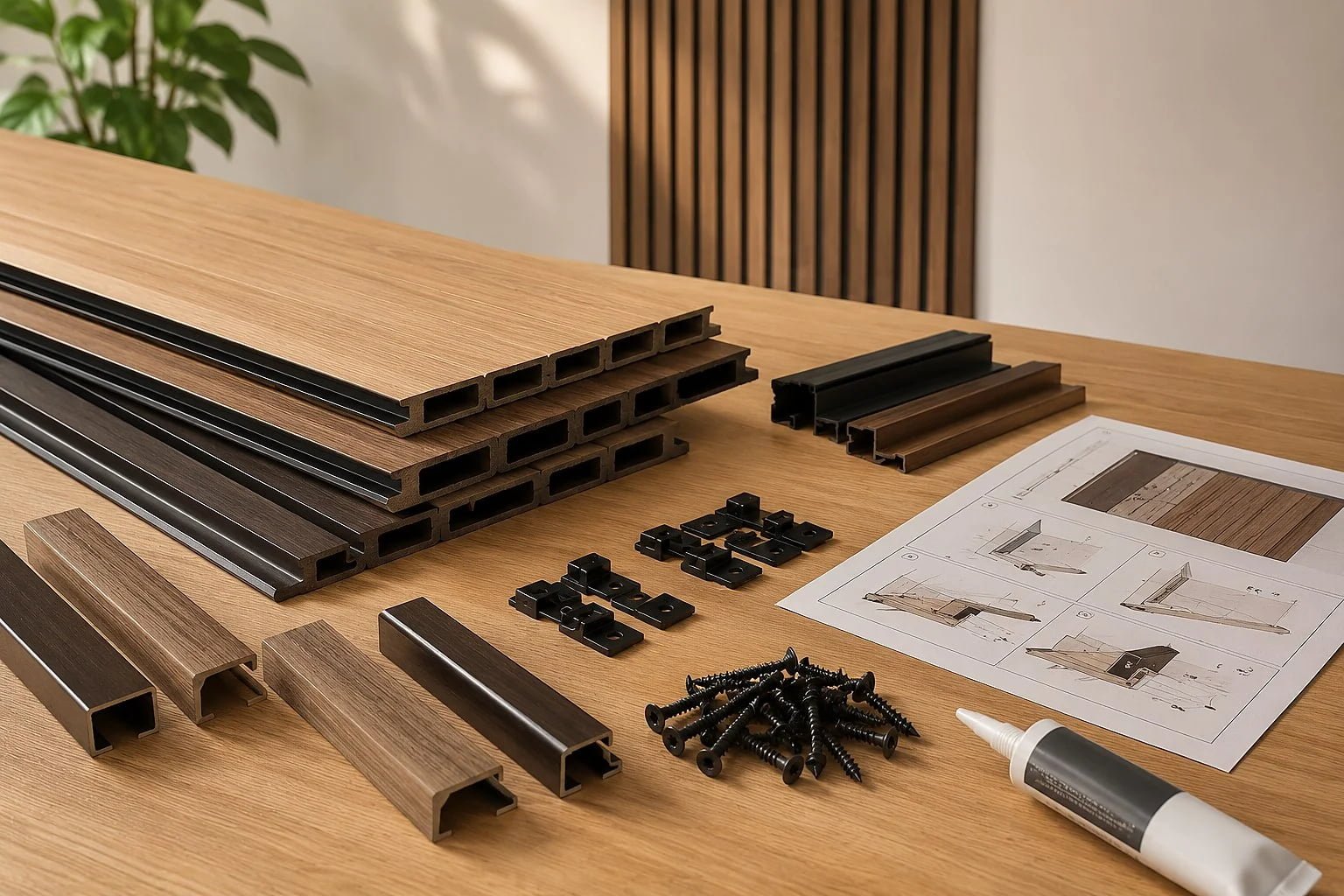
A supplier may promise a 15-day lead time, but that figure should have a clear starting point. It could mean 15 days after deposit, after artwork approval, after color confirmation, or after raw materials arrive.
I ask for:
- The production start condition
- The scheduled completion date
- The inspection date
- The latest container-loading date
- The response if production is delayed
- The treatment of custom colors
- The capacity available during peak season
As a trading business, we often see direct factory quotations that are approximately US$0.05–US$0.10/m² lower than trader quotations9 for highly standardized products. That difference is commercially important on a full container. However, buyers should also compare who manages inspection, document correction, mixed-color coordination, replacement claims, and shipment follow-up.
Inspect bulk goods before loading
I recommend a pre-shipment inspection based on the signed purchase specification. The inspection can include:
- Random dimensional checks
- Piece-weight checks
- Visual comparison with the approved sample
- Surface-film and color checks
- Profile cross-section verification
- Package count
- Carton or wrapping condition
- Loading supervision
- Container condition
- Seal-number recording
A third-party inspection company can provide independent checks10 when the order value or project risk justifies the cost. A qualified laboratory or technical professional should evaluate application-specific performance claims.
Check customs and certification documents
In our handled export context, this PVC-based wall-panel category is declared under HS 3925.9011. However, customs classification can depend on product composition, construction, use, and destination-country interpretation. I advise importers to confirm the code with a licensed customs broker or relevant authority before shipment.
I also ask suppliers to provide draft documents early, including:
- Commercial invoice
- Packing list
- Bill of lading instructions
- Certificate of origin when applicable
- Product description and HS code
- Test reports requested by the destination market
- Conformity documents where legally required
- Insurance documents under the agreed trade term
I treat certificates and test reports as documents to verify, not as automatic proof that every production batch meets a project requirement. Buyers should confirm the issuing body, report number, product model, test standard, validity, and destination acceptance.
Frequently Asked Questions
How much does one WPC panel cost?
A 3,000 × 400 mm panel covers a nominal 1.2 m². At a conditional price of US$2.30–US$3.20/m², one panel would cost approximately US$2.76–US$3.84 FOB China. This estimate excludes freight, duty, clearance, and destination delivery.
Are cheaper WPC panels always lower quality?
No. A lower price may result from efficient production, a large order, standard colors, or better loading. It may also reflect lower weight, thinner profile walls, simpler packaging, or a different formulation. I verify the complete specification before judging quality or value.
Should I compare WPC panels by piece or square meter?
I prefer square meters because panel lengths and widths can differ. However, I also check the effective installed coverage, pieces per package, unit weight, and container quantity. A square-meter comparison remains misleading if the products have different structures or usable widths.
How many WPC panels fit in a 40HQ container?
The quantity depends on panel length, width, gross weight, packaging, and the container’s verified payload. For 3,000 × 400 × 8 mm engineering panels, weight may limit the shipment before volume does. I ask for a written loading plan rather than relying on a universal quantity.
What payment terms are common for full-container orders?
Many importers request 30% deposit and 70% against a copy of the bill of lading12, but terms depend on supplier history, country risk, order size, and credit arrangements. I recommend matching payment milestones to inspection, loading, and document approval whenever commercially possible.
Conclusion: What Should WPC Panels Really Cost?
WPC panels do not have one reliable universal price. For 3,000 × 400 × 8 mm hollow PVC-based engineering products, I use US$2.30–US$3.20/m² FOB China as a conditional first-half 2026 reference, subject to current verification. The safer decision comes from comparing composition, dimensions, weight, finish, packaging, loading quantity, expected damage, and landed container cost. Contact JH WPC Wall Panel CO., LTD for a specification-based quotation, loading plan, and document checklist for your target market.
References
-
A Critical Review on Wood-Based Polymer Composites — PMC / NIH
-
A Concise Review of the Components and Properties of Wood–Plastic Composites — PMC
-
Load Securement and Packaging Methods to Reduce Risk of Damage — RIT
-
Design Approach Using Effective Widths in Elastic Range — PMC
-
International Convention for Safe Containers — Regulations.gov
-
Determine Total Export Price — International Trade Administration
-
Impact of National Volume-Based Procurement Reform on Markup — PMC
-
ISO 2859-1:2026 — Sampling Procedures for Inspection by Attributes
-
Documentary Collections — International Trade Administration